Explore projects
-
 Balloon Analogue Risk Task (BART)
The experiment: ——
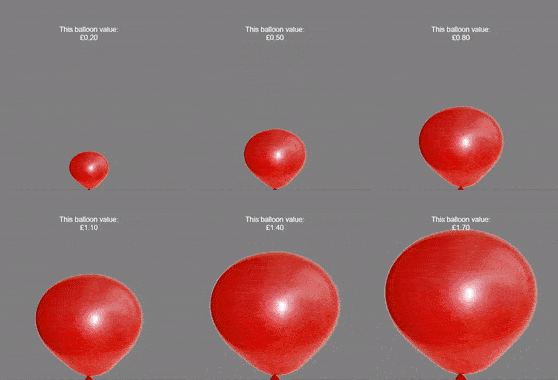
This is a simplified (and prettified) version of the BART task by Lejuez et al (2002). Participants have to blow up a balloon that they know will burst at some point. They ‘earn’ rewards for getting the balloons to be larger, but increase the risk of bursting it, in which case they earn no reward for that balloon. The question is, how many times does someone pump each balloon trying to optimise their rewards.
The measure is designed to quantify individual differences in risk-taking.
Analysing your data: ——
You should filter out data where the balloon burst and measure the number of pumps made for the remaining trials.
Notes: ——
WARNING: This is an advanced demo involving lots of code components
This can be extended to be more similar to the original paper by adding further colours of balloons with different bursting profiles.
Updated -

A basic n-back task in which sequential items are presented. Participants must click/tap the screen if this item is the same as n-back.
Updated -

Welcome to the Facial Emotion Detection Task. To maintain your anonymity do not enter your real name below.
The task may take up to 5 minutes to load. Your patience is appreciated.
Updated -
Updated
-
Updated
-
Updated
-

-
This experiment demonstrates the effect of using the three units "pix", "height" and "norm" on the scaling of images with PsychoJS. Proceed throught the experiment and resize your Browser window while viewing the images in order to see the effect.
Updated -
Race categorization task in which participants are asked to respond 'black' or 'white' to faces presented for750 ms. The stimuli set comprises 16 face models (8 female; 8 male). Each model is presented in 11 racial morphing levels, totaling 176 trials +20 training trials. Response rate can be adjusted in an appropriate funcion (e.g., logistic) to calculate categorization threshold and slope. Developed by 'Grupo de Pesquisa em Percepção Visual' at University of Brasília, Brazil.
Updated -
Bandit game, part of a PhD project at Philiastides Lab, The University of Glasgow. In this game, participants select between pair of slot machines (overall 4 stimuli) with the aim to maximise the total points won.
Updated -
Updated
-

In this task participants are required to press either left or right arrow key depending on which way the fish in centre is facing. Participants are required to ignore the direction of the surrounding fish. This is a children version of Flanker Task based on M. Rosario Rueda et al. (2004).
Updated -
Updated
-
Updated
-