Explore projects
-
Online version of stylus maze used by Brenda Milner et. al. in their studies of Amnesic patients.
Updated -
Repository for concept creep project(s).
Updated -

-
 Updated
 -

-
-
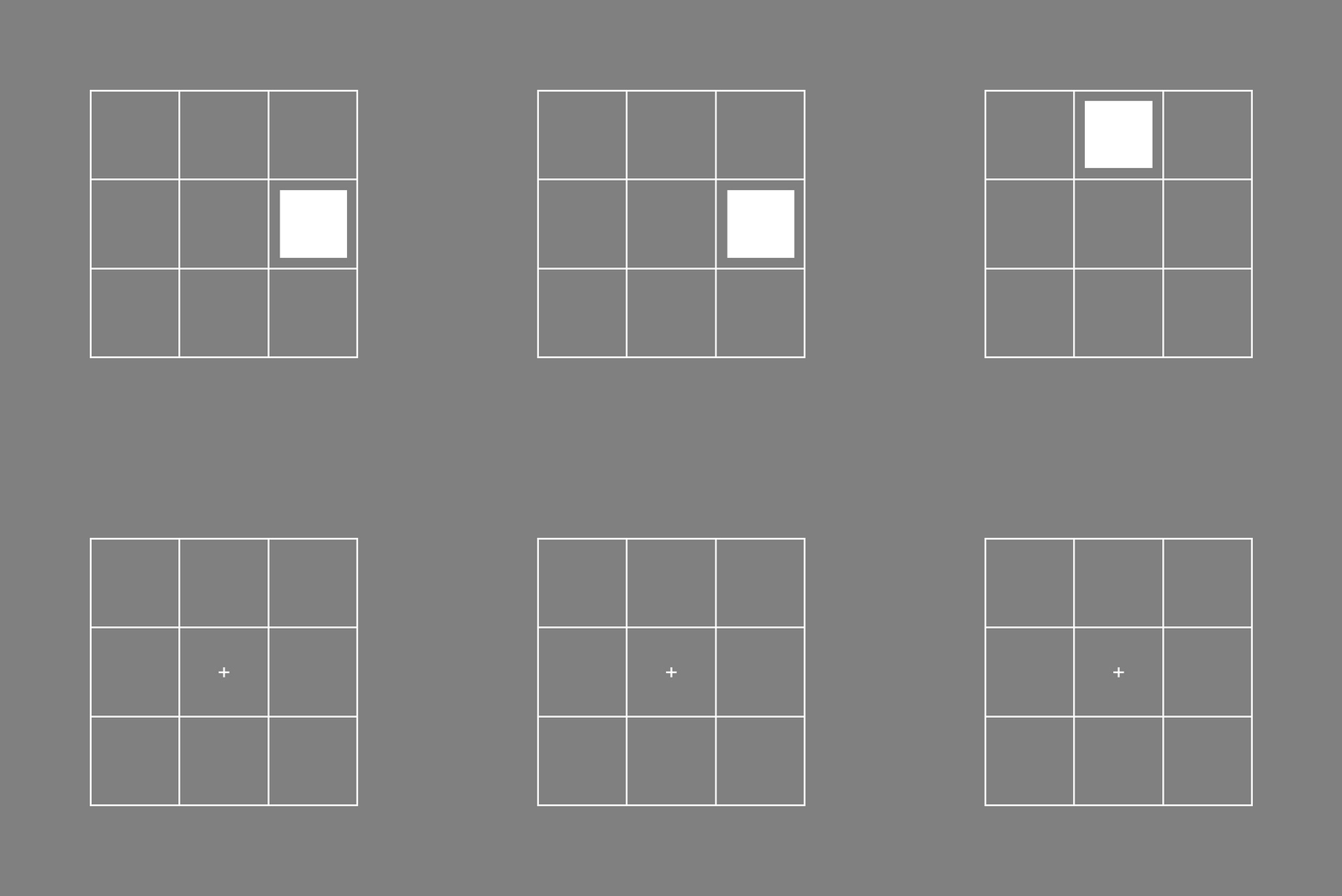
In this experiment participants are required to respond whenever the stimulus (square) location matches its location the previous trial (N-back-1). N-back-2 trials involve responding whenever the location of the square is the same as its location 2 trials before. This task is based on Kirchner (1958) experiment.
Updated -

In this task partcipants are required to sort the presented stimuli based on shape, while ignoring the position of the stimuli. This experiment is based on Huettel & McCarthy (2004) experiment.
Updated -
Updated
-
Updated
-
Sustained Attention to Response Time Task (SART)
This SART task is modeled on the framework used in The Irish Longitudinal Study on Ageing (TILDA)
Participants must press a button (mouse or onscreen) in response to a series of digits and withold responses on the number 3)
Each digit appears for 300ms, with an interval of 800ms between digits. The cycle of digits 1–9 is repeated 23 times, giving a total of 207 trials. The task lasts approximately for 4min
Citations
Robertson I. H. Manly T. Andrade J. Baddeley B. T. Yiend J . (1997). ‘Oops!’: Performance correlates of everyday attentional failures in traumatic brain injured and normal subjects. Neuropsychologia, 35, 747–758. doi:S0028-3932(97)00015-8 [pii]
Aisling M. O’Halloran, Ciaran Finucane, George M. Savva, Ian H. Robertson, Rose Anne Kenny, Sustained Attention and Frailty in the Older Adult Population, The Journals of Gerontology: Series B, Volume 69, Issue 2, March 2014, Pages 147–156, https://doi.org/10.1093/geronb/gbt009
Updated -
Updated
-
This is code for the replication of Seli et al. (2016), which is part of the Collaborative Replication and Education Projects (CREP). I share this for other to try out and use.
Note that this public experiment only involves 2 blocks of 45 trials for piloting purposes. The code in the routine SetBlockLengths allows you to change this (to 20 if you are replicating Seli et al., 2016).
Also note that I disabled actual submitting of data by Never stopping the routine Debrief. This means you can only exit the experiment by pressing 'Esc' and closing the browser window. My settings on Pavlovia are such that in that case no data is saved. If you use this for your own experimentation, you should in the routine Debrief change the settting of Debrief_mouse: 'End routine on press' to 'valid click'.
Updated -
Series of cognitive tests including: Verbal Fluency, Semantic Judgment Task, Forward Flow, Alternative Uses Task, Cattell, Demographics
Updated