Explore projects
-
Updated
-
This study aims to explore the theory of double consciousness by investigating how different forms of racial priming affect the cognitive performance of African American students in an end-back matching task.
Updated -
This is a demo to show how one can use slider position to change the opacity of an image (in this case: a lightbulb).
Updated -
In this experiment, you will see a set of colored squares. On half of the trials, a cue will direct you to maintain items in either the left or right visual field after a brief delay.
Updated -
-
-
Updated
-

A demo based on the Eriksen Flanker paradigm. Participants respond to the direction of a central arrow, whilst ignoring distracting flankers.
Updated -
-
Updated
-
Animal stroop task - based on Reynvoet et al 2021 and adapted for children In the Animal Stroop tasks, participants are instructed to respond to one piece of relevant information about a stimulus while ignoring the other, often more salient, piece of information. Two animals picture are presented on each trial simultaneously. Participants need to indicate which animal is larger in real life and ignore the size of the image. Two large animals (elephant or bear) coupled with two small animals (rabbit or butterfly) are presented. 1/2 congruent trials: the image of the larger real-life animal (elephant or bear) is larger than the smallest animal (butterfly or rabbit). 1/2 incongruent trials: the image of largest real-life animal is presented smaller than the image of the smallest real-life animal. Stimuli are a total of 16 pairs: 2 small animals x 2 large animals x 2 size (congr|incongr) x 2 sides (left|right) 16 practice trials with feedback; 48 test trials fixation cross 500ms Stimulus on the screen until a response is given. Blank screen 500ms Response: 'f' key for left, 'j' for right Inhibition is measured by an interference score for each task by subtracting the mean response time (RT)/mean accuracy on correct congruent trials from the mean RT/mean accuracy on correct incongruent trials.
Updated -
The purpose is the test which kind of emotion affects memory Using images with relative music for test memory
Updated -
Experimenting with a slider that can be controlled using the keyboard or mouse hover.
Updated -
This IAT is availible to the public for use.
After forking, please review the algorithm for determining IAT scores prior to unveiling the IAT to your participants. IAT scores are calculated in the code component of the Last_Block.
Note, this is designed to be both intuitive and easy to alter for your own purposes. Use wisely.
The Algorithm is based of Greenwalk, Nosek, and Banaji (2003).
Those with questions can contact lirivera@wisc.edu Copyright 2019, Laur Rivera, All rights reserved.
Updated -
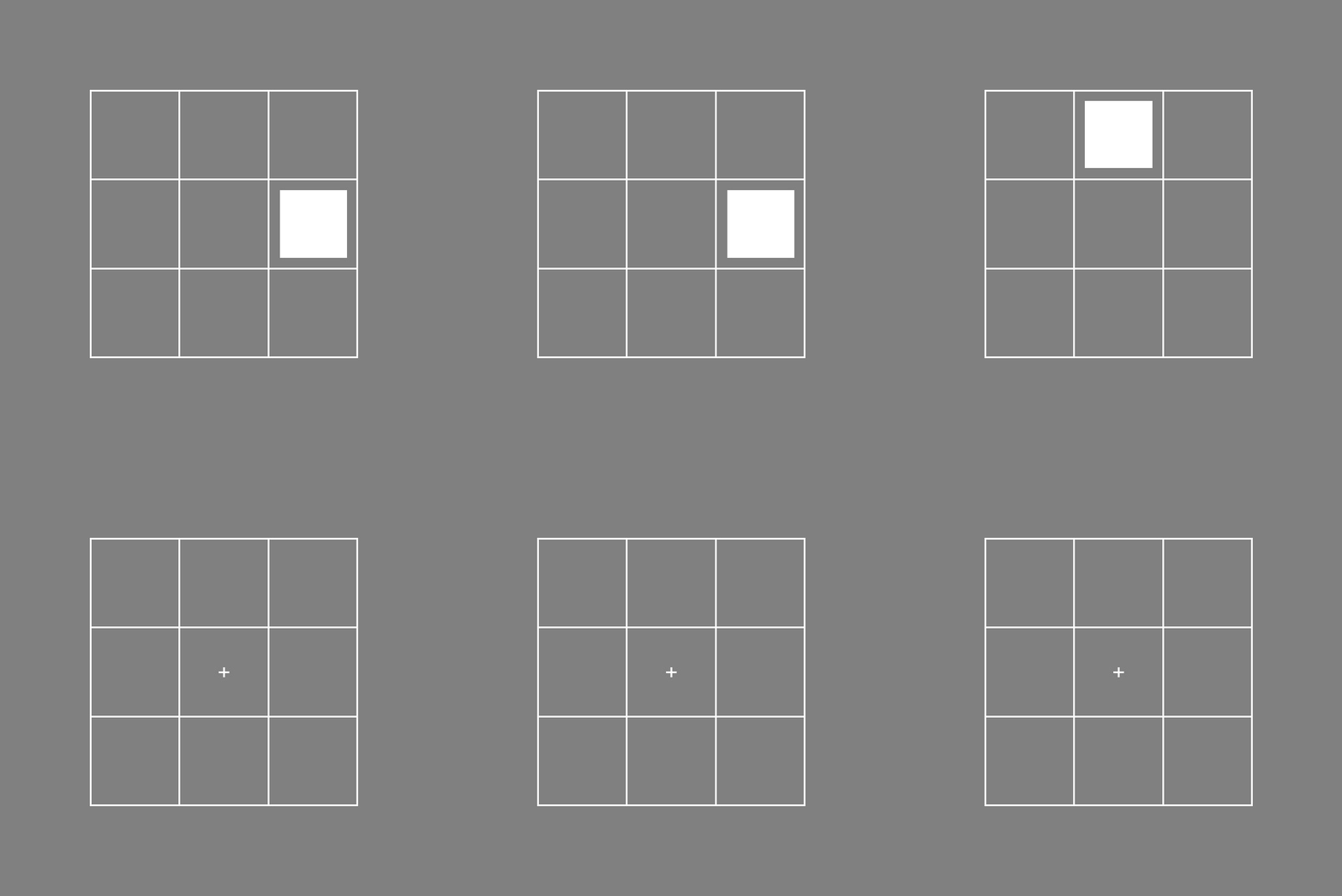
In this experiment participants are required to respond whenever the stimulus (square) location matches its location the previous trial (N-back-1). N-back-2 trials involve responding whenever the location of the square is the same as its location 2 trials before. This task is based on Kirchner (1958) experiment.
Updated -
-
An escape room ... of bugs.
Here I have delibrately planted a range of bugs for you to crack...
Good luck getting out!
Hopefully you learn some JS and web skills on the way!
Updated -
Updated
-
Open sourced Implicit Association Test (IAT) as a demonstration. This version will run locally in PsychoPy (mouse input) or online (including touchscreen input)
Updated