Explore projects
-
-
A simple demo of audiovisual temporal adaptation. Participants are presented with sets of flash-beep pairs. In the adaptation block participants passively watch the stimuli. In the respond block participants judge if the beep or flash was presented first.
Sensory adaptation occurs when participants judgements are shifted by a period of training (e.g. first presenting stimuli with an audio-lead lag may later bias participants to respond that they heard the beep first)
Updated -
Dot-probe task with nicotine images, the following project includes two type of nicotine stimuli: primary stimuli and secondary stimuli, each one containing a total of 12 pair of images repeated 4 times in a random way (48 trials per stimuli type). Between the primary and secondary stimuli there is a 2 minutes pause to let the subject recover its attention. There is a random loop to allow the primary and secondary stimuli to always be selected in a different random order
Updated -
Updated
-
Updated
-

In this task participants are required to memorise and recall number series in order. Participants start out with three 3-digit sequences. If participants correctly recall 2 out of 3 three sequences, they progress to 4-digit sequence trials and so on. If participants respond incorrectly on 2/3 trials the experiment terminantes. This experiment is based on the original digit span experiment by Jacobs (1887).
Updated -

In this task participants are required to sort the presented cards based on a rule. The rule is unknown to the participants, however they receive feedback whether their answer was correct. The rule changes after certain amount of trials. This experiment is based on Grant & Berg (1948) experiment.
Updated -
Go/no-go task based on Redick et al.’s (2011) article “Working Memory Capacity and Go/No-Go Task Performance: Selective Effects of Updating, Maintenance, and Inhibition”.
Updated -
Updated
-
Please Cite: Bölling, L., 2022-01-14. HTML Instructions for Online-Experiments in PsychoPy [Computer software]. Pavlovia. https://gitlab.pavlovia.org/luke.boelling/htmlinstructionsdemo.
Updated -
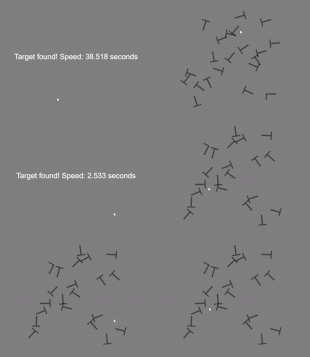
Demo of a visual search task for use online. User can manipulate setsize, target colour, letter orientation. Accuracy and response time recorded.
Updated -
-

In this task participants are required to press either left or right arrow key depending on which way the fish in centre is facing. Participants are required to ignore the direction of the surrounding fish. This is a children version of Flanker Task based on M. Rosario Rueda et al. (2004).
Updated -
The purpose is the test which kind of emotion affects memory Using images with relative music for test memory
Updated -
Updated
-
Classic Shepard & Metzler mental rotation task. 20 items. Two practice items. Feedback after each response.
Updated -