Explore projects
-
-
 Updated
 -

This task shows you the drag and drop capabilities of PsychoPy and PsychoJS. The demonstration uses a drag and drop puzzle game. The task requires you to drag and drop the black and white pieces into the empty square.
Updated -
Updated
-
Updated
-
Updated
-
-
Updated
-
Updated
-
This is a demo version of the Stroop task modified by Cui et al (2008), to be used to test priming by colors and its association with imagery vividness
Updated -
Updated
-
Updated
-
Parametric Go No/Go Stop with Shapes 2target, 3 target, 6 blocks
Updated -

In this task participants are required to sort the presented cards based on a rule. The rule is unknown to the participants, however they receive feedback whether their answer was correct. The rule changes after certain amount of trials. This experiment is based on Grant & Berg (1948) experiment.
Updated -
Please cite: Bölling, L., 2022-03-10. Dropdown-Field-Snippet for Online and Offline Usage in PsychoPy-Builder [Computer software]. Pavlovia. https://gitlab.pavlovia.org/luke.boelling/dropdownonlineoffline.
Updated -
-
Updated
-
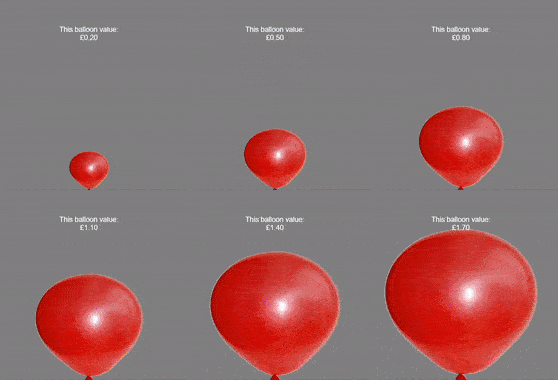 Balloon Analogue Risk Task (BART)
The experiment: ——
This is a simplified (and prettified) version of the BART task by Lejuez et al (2002). Participants have to blow up a balloon that they know will burst at some point. They ‘earn’ rewards for getting the balloons to be larger, but increase the risk of bursting it, in which case they earn no reward for that balloon. The question is, how many times does someone pump each balloon trying to optimise their rewards.
The measure is designed to quantify individual differences in risk-taking.
Analysing your data: ——
You should filter out data where the balloon burst and measure the number of pumps made for the remaining trials.
Notes: ——
WARNING: This is an advanced demo involving lots of code components
This can be extended to be more similar to the original paper by adding further colours of balloons with different bursting profiles.
Updated