Explore projects
-
-
An escape room ... of bugs.
Here I have delibrately planted a range of bugs for you to crack...
Good luck getting out!
Hopefully you learn some JS and web skills on the way!
Updated -
Discourse prominence experiment of my doctoral dissertation "Differential object indexing in Bulgarian"
Updated -

This task shows you the drag and drop capabilities of PsychoPy and PsychoJS. The demonstration uses a drag and drop puzzle game. The task requires you to drag and drop the black and white pieces into the empty square.
Updated -
Go/no-go task based on Redick et al.’s (2011) article “Working Memory Capacity and Go/No-Go Task Performance: Selective Effects of Updating, Maintenance, and Inhibition”.
Updated -

In this task, participants are required to judge whether a string of letters is a word or a non-word. This experiment is based on Meyer & Schvaneveldt (1971) experiment.
Updated -
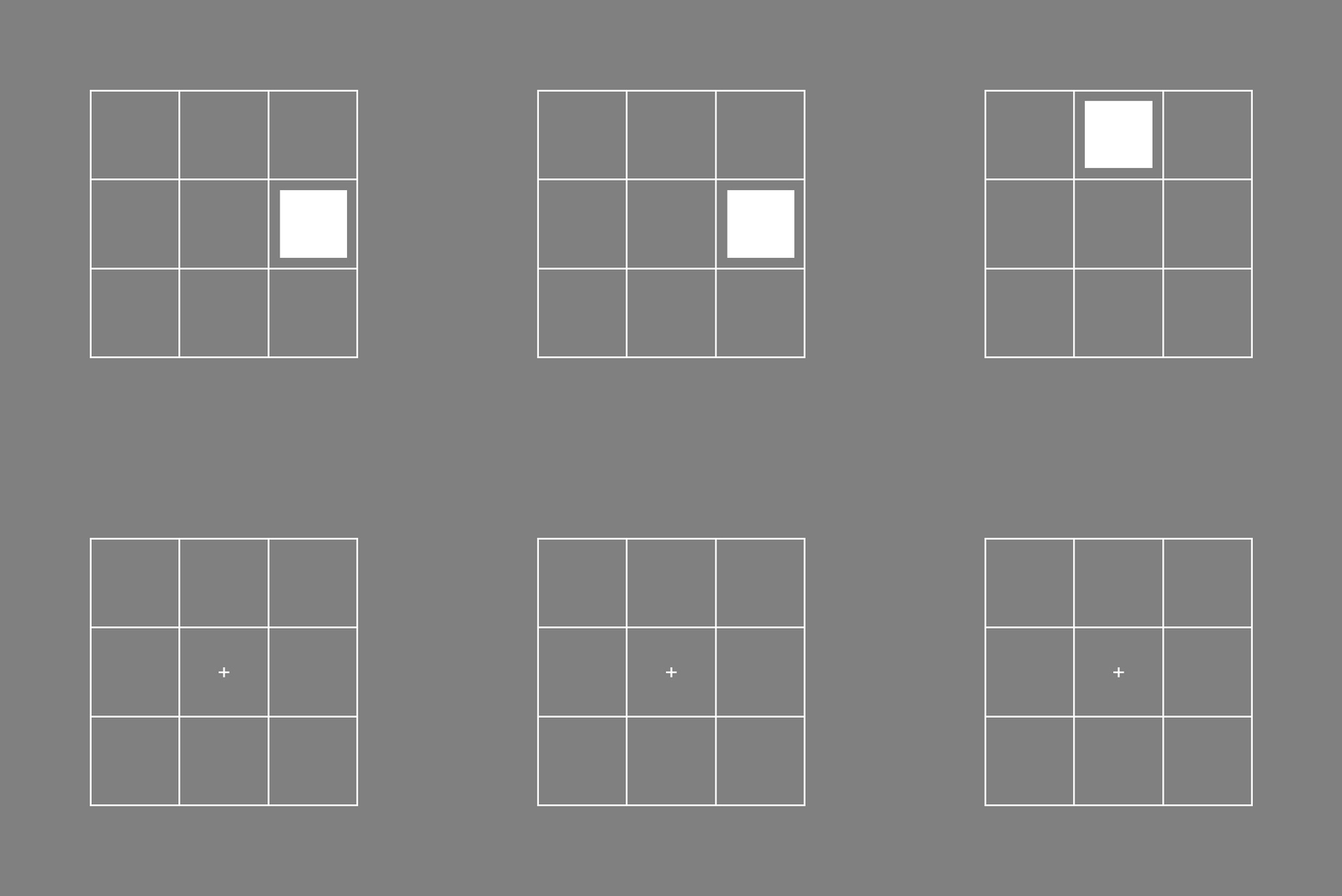
In this experiment participants are required to respond whenever the stimulus (square) location matches its location the previous trial (N-back-1). N-back-2 trials involve responding whenever the location of the square is the same as its location 2 trials before. This task is based on Kirchner (1958) experiment.
Updated -
Numerosity Comparison task | G&R paradigm
Version for 6-7-years-old children
N tot trials = 48
Numerosity range: 10 to 40 dots Numerosity ratio: 1.20, 1.25, 1.50, 2.00 12 trials per ratio
NOTE: selected 24 pairs x 2 positions Correct Answer (left|right)
Visual cues manipulation: Fully Congruent | Fully Incongruent
Stimuli on the screen till resp is given 1s ITI
Key responses: 'f' and 'j' (for left and right respectively)
Updated -
-
-
Created for Eliza Yujun Ng December 2018
Numbers are presented at a rate of one per second. The first digit cannot be 0 Following digits can be 0 but cannot be the same as the previous digit.
If the answer is correct the span is increased for the next trial If the answer is wrong the span is decreased for the next trial
If there are at least two errors at a given span and that represents more than half of the total attempts at that span then the experiment ends, returning a span of one less than the final span attempted.
Updated -
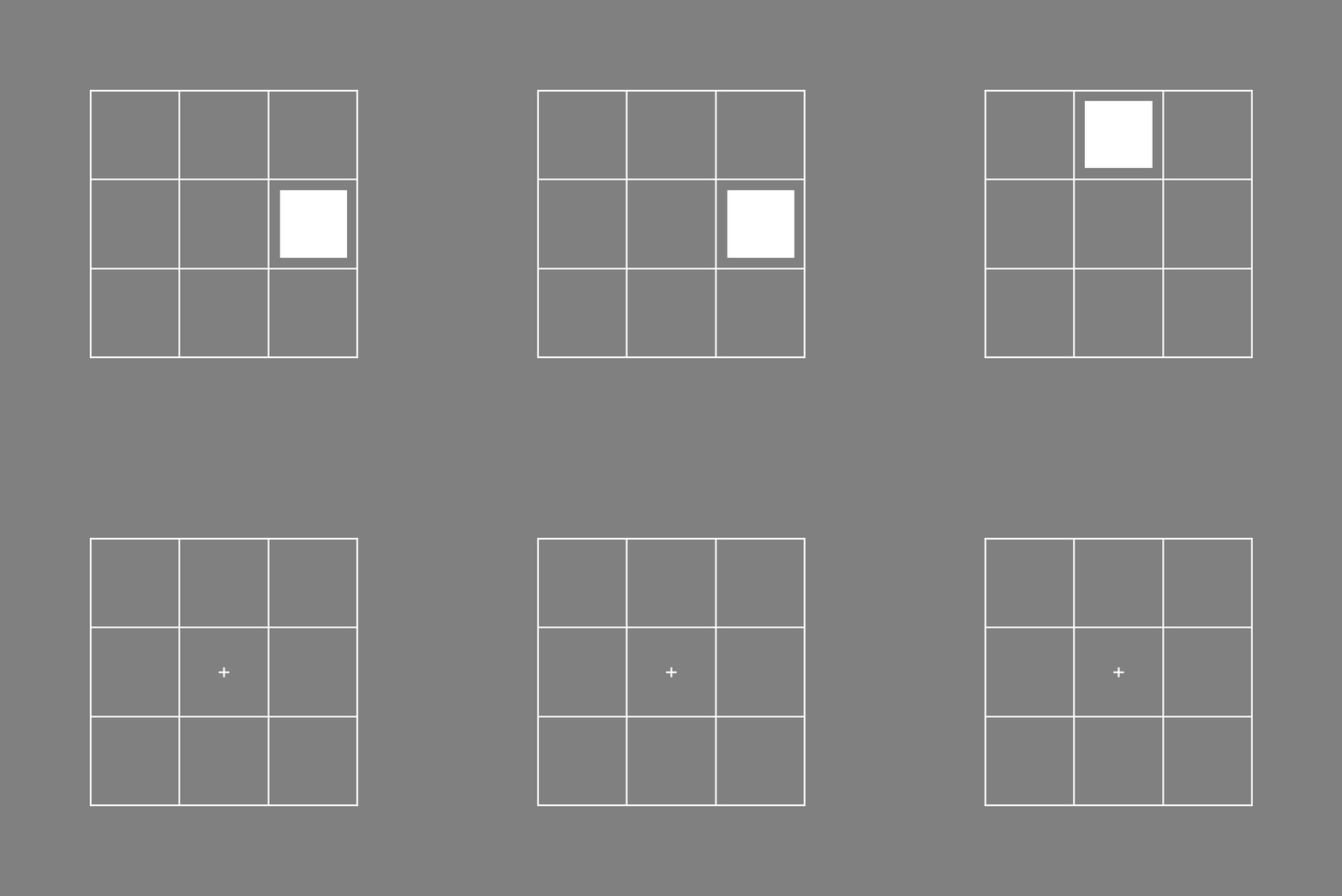
In this experiment participants are required to respond whenever the stimulus (square) location matches its location the previous trial (N-back-1). N-back-2 trials involve responding whenever the location of the square is the same as its location 2 trials before. This task is based on Kirchner (1958) experiment.
Updated -
Updated
-

GFMT (Burton et al 2010) is a face perception task to test the ability to tell two faces are the same person
Updated -

Modern Emotion Recognition Test [MERT]: examines facial emotion recognition using 60 items of the six basic emotions anger, disgust, dear, happiness, sadness, and surprise. Developed by NF, Megan Barnett, Prof Lucia Valmaggia, and Prof Robin Morris.
Updated -
Use the mouse to control what part of an image you can see. This demo shows you how easy it is to build rich dynamic studies using only the Builder view.
Updated -
Use the mouse to control what part of an image you can see. This demo shows you how easy it is to build rich dynamic studies using only the Builder view.
Updated -
Use the mouse to control what part of an image you can see. This demo shows you how easy it is to build rich dynamic studies using only the Builder view.
Updated -

A demo based on the Corsi blocks task. Tests Spatial memory. Participants must remember the order in which a series of blocks change colour.
Updated -
Created for Eliza Yujun Ng December 2018
Numbers are presented at a rate of one per second. The first digit cannot be 0 Following digits can be 0 but cannot be the same as the previous digit.
If the answer is correct the span is increased for the next trial If the answer is wrong the span is decreased for the next trial
If there are at least two errors at a given span and that represents more than half of the total attempts at that span then the experiment ends, returning a span of one less than the final span attempted.
Updated