Explore projects
-
Go/no-go task based on Redick et al.’s (2011) article “Working Memory Capacity and Go/No-Go Task Performance: Selective Effects of Updating, Maintenance, and Inhibition”.
Updated -

In this task participants are required to judge which line is longer than the other. This experiment is based on illusion devised by Franz Carl Müller-Lyer in 1889.
Updated -

-
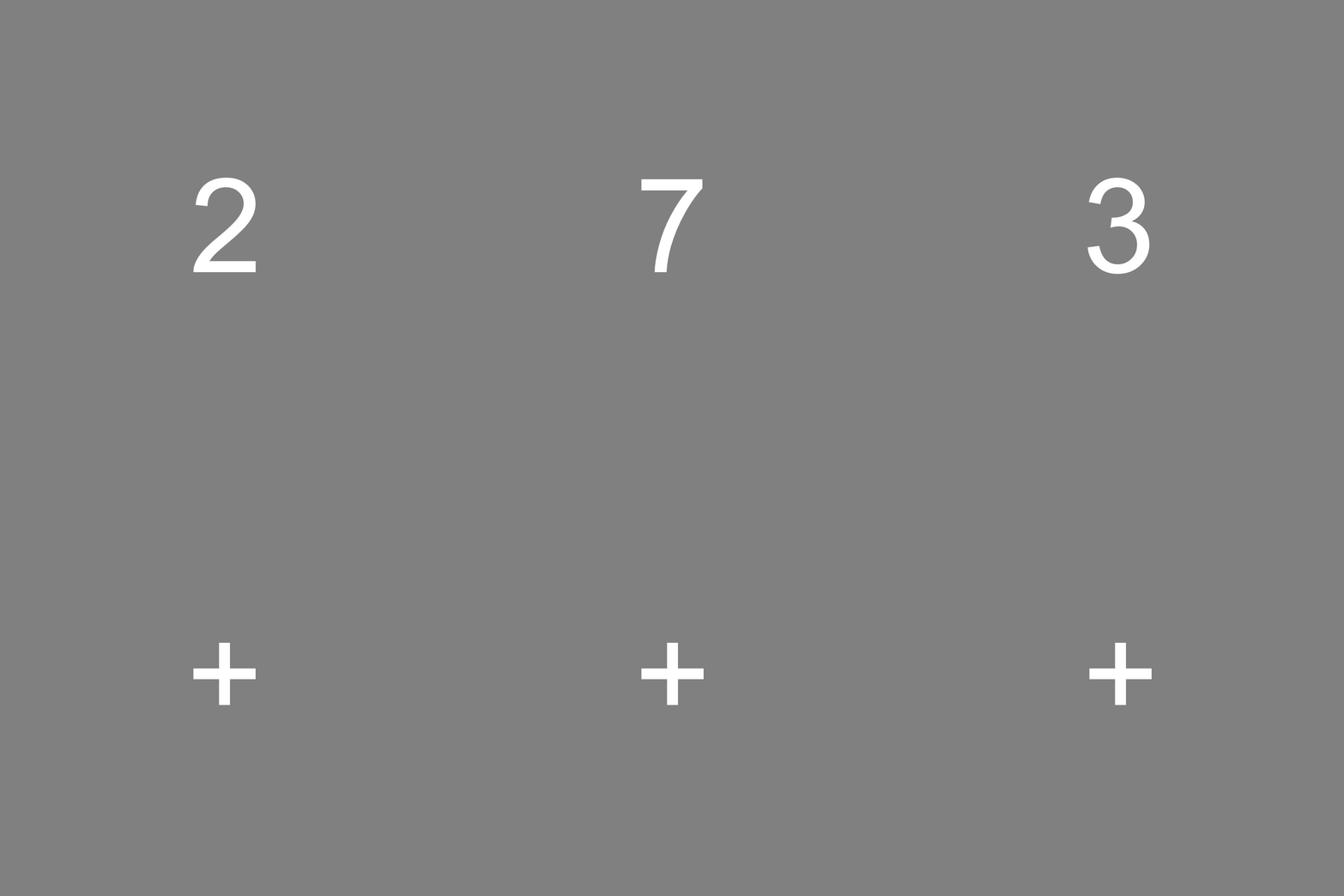
In this task participants are required to memorise and recall number series in order. Participants start out with three 3-digit sequences. If participants correctly recall 2 out of 3 three sequences, they progress to 4-digit sequence trials and so on. If participants respond incorrectly on 2/3 trials the experiment terminantes. This experiment is based on the original digit span experiment by Jacobs (1887).
Updated -
Go/no-go task based on Redick et al.’s (2011) article “Working Memory Capacity and Go/No-Go Task Performance: Selective Effects of Updating, Maintenance, and Inhibition”.
Updated -

-

In this task participants are required to sort the presented cards based on a rule. The rule is unknown to the participants, however they receive feedback whether their answer was correct. The rule changes after certain amount of trials. This experiment is based on Grant & Berg (1948) experiment.
Updated -

In this task participants are required to sort the presented cards based on a rule. The rule is unknown to the participants, however they receive feedback whether their answer was correct. The rule changes after certain amount of trials. This experiment is based on Grant & Berg (1948) experiment.
Updated -
Updated
-
-
Use the mouse to control what part of an image you can see. This demo shows you how easy it is to build rich dynamic studies using only the Builder view.
Updated -
-
Updated
-
The Jena Voice Learning Test (JVLMT) is a 22 min standardized tool to measure human voice memory capacity. It was devoloped by Humble et al. (2022). For more information see https://osf.io/cyr23/
Updated -
Sample jsPsych experiment using a standard two-alternative forced-choice paradigm. On each trial a quote is printed on the screen and participants must decide whether it comes from Shakespeare or Tupac. Feedback provided. Six trials.
Updated -
-