Explore projects
-
Updated
-
-
-
-
-
Updated
-

A demo based on the Glasgow Face Matching task. Used in the study of face perception.
Updated -
-
-
A simple demo of audiovisual temporal adaptation. Participants are presented with sets of flash-beep pairs. In the adaptation block participants passively watch the stimuli. In the respond block participants judge if the beep or flash was presented first.
Sensory adaptation occurs when participants judgements are shifted by a period of training (e.g. first presenting stimuli with an audio-lead lag may later bias participants to respond that they heard the beep first)
Updated -

In this task participants are required to memorise and recall number series in order. Participants start out with three 3-digit sequences. If participants correctly recall 2 out of 3 three sequences, they progress to 4-digit sequence trials and so on. If participants respond incorrectly on 2/3 trials the experiment terminantes. This experiment is based on the original digit span experiment by Jacobs (1887).
Updated -
 Updated
 -

This task shows you the drag and drop capabilities of PsychoPy and PsychoJS. The demonstration uses a drag and drop puzzle game. The task requires you to drag and drop the black and white pieces into the empty square.
Updated -
Updated
-
-
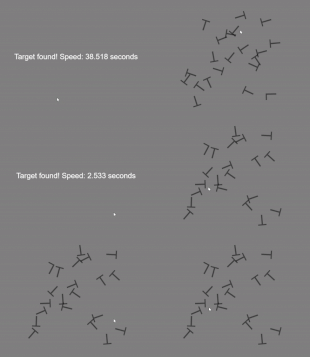
Demo of a visual search task for use online. User can manipulate setsize, target colour, letter orientation. Accuracy and response time recorded.
Updated -
-
Dot-probe task with nicotine images, the following project includes two type of nicotine stimuli: primary stimuli and secondary stimuli, each one containing a total of 12 pair of images repeated 4 times in a random way (48 trials per stimuli type). Between the primary and secondary stimuli there is a 2 minutes pause to let the subject recover its attention. There is a random loop to allow the primary and secondary stimuli to always be selected in a different random order
Updated