Explore projects
-
Updated
-
Subliminal priming experiment for Alllgemeine Psychologie I, Ulm University, Winter semester 2020-2021
Updated -
Updated
-
-
Iowa Gambling Task (Bechara et al., 1994) with confidence ratings.
Updated -
Updated
-
The purpose of this study is to learn more about human time perception and the factors that pertain to it. Specifically, I am interested in the affects of music on time perception.
Updated -
-
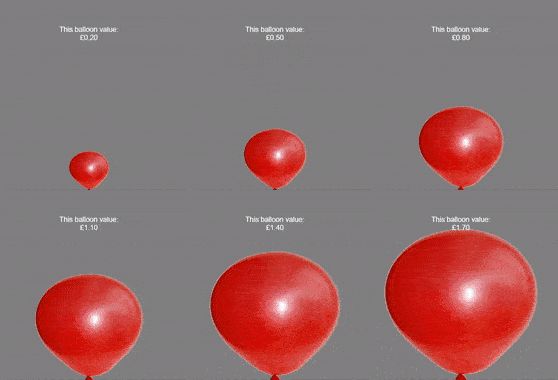 Balloon Analogue Risk Task (BART)
The experiment: ——
This is a simplified (and prettified) version of the BART task by Lejuez et al (2002). Participants have to blow up a balloon that they know will burst at some point. They ‘earn’ rewards for getting the balloons to be larger, but increase the risk of bursting it, in which case they earn no reward for that balloon. The question is, how many times does someone pump each balloon trying to optimise their rewards.
The measure is designed to quantify individual differences in risk-taking.
Analysing your data: ——
You should filter out data where the balloon burst and measure the number of pumps made for the remaining trials.
Notes: ——
WARNING: This is an advanced demo involving lots of code components
This can be extended to be more similar to the original paper by adding further colours of balloons with different bursting profiles.
Updated -
Updated
-
This is a modified version of the tower of london jspsyxh experiment avaialble here: https://gitlab.pavlovia.org/cglabbach/tower-of-london. Modifications are intended to integrate the experiment with Pavlovia.
Updated