Explore projects
-
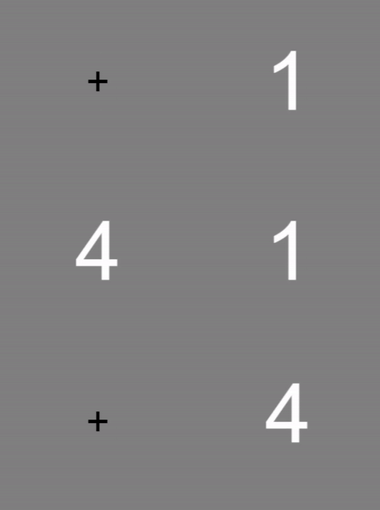
A basic n-back task in which sequential items are presented. Participants must click/tap the screen if this item is the same as n-back.
Updated -
Updated
-

In this task participants are required to memorise a sequence of square locations. Square position presentation is interrupted by symmetry trails. In symmetry trials participants are required to judge whether the presented picture is vertically symmetrical. Square presentation and symmetry trials are repeated until participants are asked to recall all square locations in sequential order. This experiment is based on Kane et al. (2004) experiment.
Updated -
-

A learning task based on the reinforcement learning model. The current version is based on the paper by Frank, Woroch and Curran. (2005). Neuron, 47(4), 495-501.
Updated -
Moves a pulsating circle around the screen like an eye tracker calibration cue. Paths are read from an Excel file but implemented in code.
Updated -
Updated
-

In this task participants are required to sort the presented cards based on a rule. The rule is unknown to the participants, however they receive feedback whether their answer was correct. The rule changes after certain amount of trials. This experiment is based on Grant & Berg (1948) experiment.
Updated -

In this task participants are required to sort the presented cards based on a rule. The rule is unknown to the participants, however they receive feedback whether their answer was correct. The rule changes after certain amount of trials. This experiment is based on Grant & Berg (1948) experiment.
Updated -
Updated
-
-
-

A demo based on Greenberg & Waldman (1993) Test of Variables of Attention.
Updated -

A demo based on Greenberg & Waldman (1993) Test of Variables of Attention.
Updated -

A demo based on the Corsi blocks task. Tests Spatial memory. Participants must remember the order in which a series of blocks change colour.
Updated -
Long context biased towards low with feedback given every 10 trials.
Updated