Explore projects
-

A basic n-back task in which sequential items are presented. Participants must click/tap the screen if this item is the same as n-back.
Updated -

In this task participants are required to press either left or right arrow key depending on which way the fish in centre is facing. Participants are required to ignore the direction of the surrounding fish. This is a children version of Flanker Task based on M. Rosario Rueda et al. (2004).
Updated -

In this task participants are required to memorise and recall number series in order. Participants start out with three 3-digit sequences. If participants correctly recall 2 out of 3 three sequences, they progress to 4-digit sequence trials and so on. If participants respond incorrectly on 2/3 trials the experiment terminantes. This experiment is based on the original digit span experiment by Jacobs (1887).
Updated -
Parametric Go No/Go Stop with Shapes 2target, 3 target, 6 blocks
Updated -
-

In this task participants are required to judge which line is longer than the other. This experiment is based on illusion devised by Franz Carl Müller-Lyer in 1889.
Updated -
-
Facial Emotion Perception Test — Five finger, multi-racial, w/ animal controls, index 1
Updated -

In this task participants are required to write down as many words as possible beginning with letters "S" and "C". This experiment is a short version of Thurstone & Thurstone (1938) Chicago word fluency test.
Updated -
-

In this task participants are required to memorise and recall number series in order. Participants start out with three 3-digit sequences. If participants correctly recall 2 out of 3 three sequences, they progress to 4-digit sequence trials and so on. If participants respond incorrectly on 2/3 trials the experiment terminantes. This experiment is based on the original digit span experiment by Jacobs (1887).
Updated -

-
A forward and Backward Digit Span test for Working Memory The test adapts to participnts' answers and a score is calculated following Woods et al. (2012)
Updated -
Race categorization task in which participants are asked to respond 'black' or 'white' to faces presented for750 ms. The stimuli set comprises 16 face models (8 female; 8 male). Each model is presented in 11 racial morphing levels, totaling 176 trials +20 training trials. Response rate can be adjusted in an appropriate funcion (e.g., logistic) to calculate categorization threshold and slope. Developed by 'Grupo de Pesquisa em Percepção Visual' at University of Brasília, Brazil.
Updated -
-
Updated
-

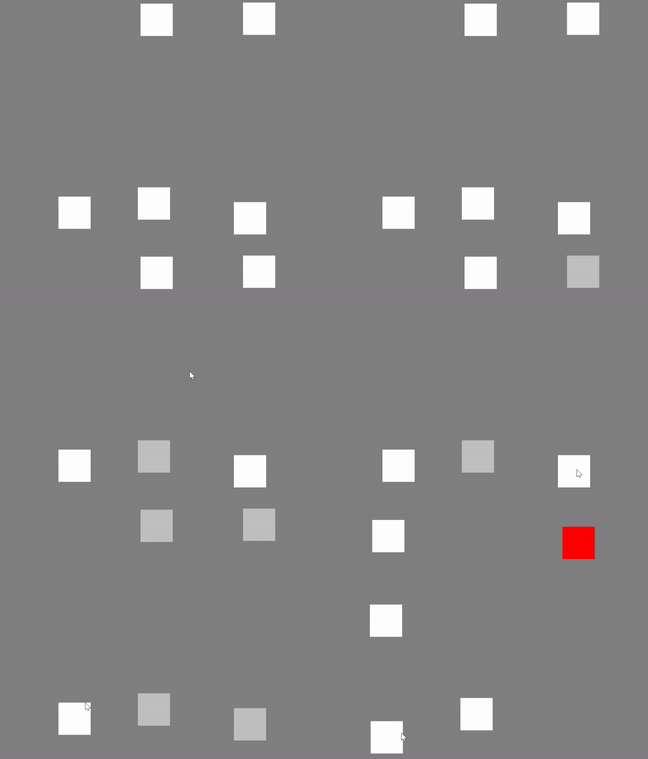
In this experiment participants are required to respond whenever the stimulus (square) location matches its location the previous trial (N-back-1). N-back-2 trials involve responding whenever the location of the square is the same as its location 2 trials before. This task is based on Kirchner (1958) experiment.
Updated -
Updated
-

-
A very simple CPT vigilance task, that is set to 10% occurence of the target
Updated